By Ellen Joan Pollock
Staff Reporter of The Wall Street Journal July 15, 1998 12:01 am ET
Sharon Baum recently made a solemn promise to her family. At her sons’ graduations from Harvard, she would turn off her cellular phone for the three days of festivities. Her family was skeptical. “It’s an extension of her forearm — so, anatomically, it’s hard to separate,” explains her son Samuel, 22 years old. Ms. Baum, a real-estate broker, kept the phone off, but still insisted on wearing a rhinestone pin reading SOLD on her lapel in the hope, she says, that she “might get a little extra business.”
This isn’t the first time Ms. Baum and her family have made an appearance on The Wall Street Journal’s front page. The last occasion, however, was a lot less joyful. Little Benjamin was sobbing a heart-rending plea: “Mommy come back.”
No, it wasn’t a dramatic tale of abandonment. Ms. Baum was simply leaving for her job at Chemical Bank.
Nowadays, many a parent will nod in recognition at such a cry. But 23 years ago, when the Journal heralded the birth of the “dual-career couple,” it was news. So was Ms. Baum’s guilty shudder and her confession that “I’d feel worse cooped up with him all day.”
The unsettling questions raised by that article went way beyond the troublesome enough issues of who would fold the laundry or stay home with a sick child. (“You can’t look it up in Dr. Spock,” a sociologist noted.) “For Married Couples,/Two Careers Can Be/Exercise in Frustration,” the headline read. What would become of the children of such couples? Would the marriages survive?
Sometimes, Ms. Baum’s husband, Stephen, said back then, “we both sit down and look at each other and wonder if it’s worth it.” For the Baums, the graduations — of Sam from college and of Ben from law school — was sort of an answer. Benjamin, the crier, is now 26 and about to join the Boston Consulting Group. Sam is starting an acting career. Last year, Sharon, as an agent with the Corcoran Group, sold more than $50 million in residential real estate in Manhattan. Stephen recently sold his management-consulting firm to Burson-Marsteller.
And they are still together.
That and a whole lot else about the lives of the professionals in the 1975 story would have been hard to predict. The stresses of managing work, love and kids have sent — and continue to send — their lives in unexpected directions. Despite the pressure, the women stuck with their careers; indeed, they frequently became more preoccupied with their jobs than their husbands were with theirs. Often the careers outlasted the marriages.
Much has changed since that article appeared. Dual-career couples were described as having “thrown aside the basic societal premise that a woman’s job is her husband’s career.” Today, of course, nobody would describe such couples as statistical “nonentities.” Yet some aspects of the article read as all too familiar even now: “In one sense, dual-career couples’ time is never quite their own.”
….
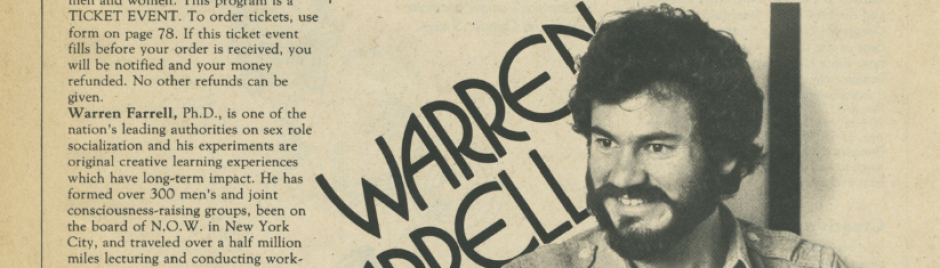
Warren Farrell
Recently, Warren Farrell spoke alongside the governor of Florida on a panel about fatherhood. In one sense, his credentials are slim. Mr. Farrell, 55, has no children. He is, however, an author and recognized guru in the men’s rights movement; he has been dubbed “the Gloria Steinem of men’s liberation.”
That wasn’t the case in 1975. Mr. Farrell reported weeping with gratitude when his wife, Ursula, made him home-cooked soup because he had a cold. “It was that feeling of being cared for,” he said. “Neither one of us has much time for these little supportive things.”
No wonder. Ursula, known as Ursie, was a rapidly ascending executive at International Business Machines Corp. Mr. Farrell had been elected three times to the board of the National Organization of Women’s New York chapter, and as a rare male feminist was much in demand as a speaker, arguing that men, too, should be freed from their traditional roles.
The two were held up in Parade magazine as the prototypical liberated couple. “Folding socks together makes laundry a bearable chore and promotes equality,” read a photo caption. If they had children, Warren told Parade, they would alternate years off from their jobs.
Then shortly after the Journal story appeared, Warren asked his wife whether, if he died, she would marry “a successful hippie” like himself. She answered that she thought she would have more in common with another IBM executive. “We sort of looked at each other and said, ‘Wow,’ ” he recalls. “We decided to really think through whether we wanted to get divorced before we had children, and say we had 10 good years together.”
In a sense, they had. When they met, Warren says, they assumed Ursie would work until they had children. That changed when she went to work at IBM. When his wife worked late, he would often bring his own work to her office, he says, recalling that he invited her boss to join his consciousness-raising group.
“We both helped each other to grow in what turned out to be two different directions,” says Warren. “She became more and more corporate, and personally, I became more and more questioning.”
When they broke up, he says, their consciousness-raising group predicted that he would remarry but that she might never. In fact, the reverse happened. Mr. Farrell has had serious relationships but hasn’t remarried. Ursie married Bill Fairbairn, another IBM executive, within a few years. As Ursula Fairbairn, she moved through several key management jobs at IBM until 1990, when she moved to Union Pacific Corp. as a senior vice president. In 1996, she became an executive vice president at American Express in charge of human resources world-wide. Mrs. Fairbairn, 55, and her husband declined to be interviewed.
Warren, meanwhile, started dating. “I saw a big difference between many other women and Ursie,” he says. “When the check came, they still assumed I would pick it up, so they were defining love as men willing to pick up the bills, and Ursie didn’t do that.” He also felt that many women he met wanted careers but didn’t want to put in the hours that men — and his former wife — were willing to work. Those realizations, he says, led his writing in new directions. In speeches and books, including “The Myth of Male Power,” he argues that men have been forced into the role of providers. “No one has resocialized the career woman to feel comfortable with marrying a man whose primary ambition is to be supportive of her.”
His ex-wife has turned out to be something of an exception, he says, Bill Fairbairn’s working life having become less dominant than his wife’s. When the couple moved to Bethlehem, Pa., where Union Pacific is based, for instance, Mr. Fairbairn became the town’s emergency-management coordinator, a part-time position, for which, according to a mayoral aide, he didn’t accept pay.
Warren now lives near San Diego. After a four-year relationship, he has started dating again and still thinks about having children. “If I had to do it over again would I have had children with Ursie and remained married? I don’t know. I come out right about even on that one. Probably 52% yes and 48% no,” he says. “Now that I look back on it, ironically, it was in the upper 10% of marriages… . One of the resistances to being remarried is finding one as good as Ursie.”